RYSE SmartShade vs. Traditional Motorized Blinds: Is the $1,500 Savings Real?
Limited Time Offer!
Get This Deal Now → *Affiliate link - We may earn a commissionWerbung | Affiliate-Link
The promise of waking up to blinds that open automatically — without leaving your bed, without fumbling for a remote, without shouting at a wall — sounds like luxury. And for years, it was. Traditional motorized blinds cost anywhere from $800 to $2,500 per window installed, which meant smart shades were firmly in the "someday" category for most people.
Then clip-on motors arrived, and the motorized blinds cost comparison changed dramatically. The RYSE SmartShade promises to deliver the same automated convenience for roughly $99 per window — a savings the company claims can top $1,500 per window versus professional systems.
But is the savings real? And what are you giving up — if anything — to get it? In this side-by-side breakdown, we cover upfront cost, installation, reliability, smart home compatibility, and who each option is actually built for. We'll be honest about the trade-offs so you can make the right call for your home.
Exclusive Discount Available Now
What We're Actually Comparing
Before diving into the numbers, it's worth being clear about what falls into each category.
Traditional motorized blinds are custom-fabricated window treatments with an electric motor built directly into the headrail. They require professional measurement, factory ordering (lead times of 4–8 weeks are common), and hard-wired or battery-integrated installation by a window treatment specialist. Brands like Lutron Serena, Hunter Douglas PowerView, and Somfy dominate this space.
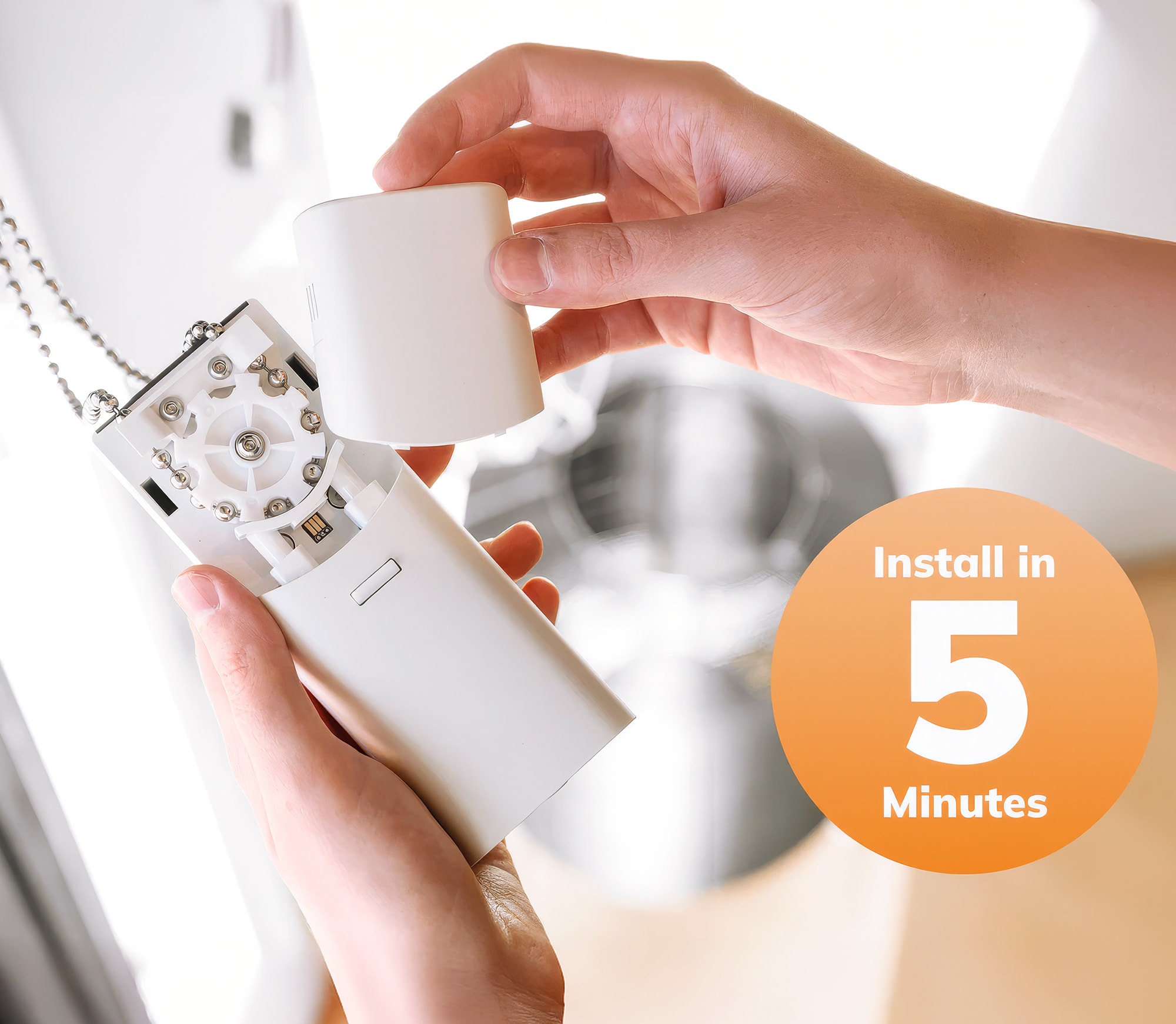
RYSE SmartShade is a battery-powered, clip-on motor that attaches to your existing roller shades, Roman shades, chain-pull blinds, or patio blinds and automates them in about five minutes. No tools. No wires. No drilling. No waiting weeks for custom fabrication.
These are fundamentally different products solving the same problem. Understanding that distinction is the whole point of this comparison.
The Real Motorized Blinds Cost: Window by Window
Let's look at the honest numbers. Cost estimates below are based on 2025–2026 industry pricing for a standard 36" x 60" window.
| Cost Factor | RYSE SmartShade | Traditional Motorized Blinds |
|---|---|---|
| Unit / Hardware Cost | ~$99 | $400–$900 |
| Professional Installation | $0 (DIY, 5 min) | $150–$600 per window |
| Wiring / Electrician | $0 (battery-powered) | $0–$500 (if hard-wired) |
| Existing Blinds Required? | Yes (use what you have) | No (all-in-one system) |
| App Subscription | Free (no subscription) | Free–$10/month depending on brand |
| Estimated Total Per Window | ~$99–$150 | $600–$1,800+ |
| 5-Window Total Estimate | ~$495–$750 | $3,000–$9,000+ |
So yes — the "$1,500 savings per window" claim holds up at the higher end of traditional motorized blind pricing, and it's conservative at the mid-to-high range. For a five-window project, the gap between the two approaches can exceed $8,000.
The important caveat: RYSE requires you to already own compatible blinds (roller shades, Roman shades, chain-pull styles). If you're starting from scratch with bare windows, add the cost of basic blinds — typically $30–$80 per window — and RYSE still wins by a wide margin.
Head-to-Head Feature Comparison
Cost is one dimension. Here's how the two approaches compare across every factor that matters day-to-day.
| Category | RYSE SmartShade | Traditional Motorized Blinds | Winner |
|---|---|---|---|
| Installation Time | 5 minutes, no tools | 1–4 weeks lead time + install day | RYSE |
| Cost Per Window | ~$99 | $600–$1,800+ | RYSE |
| Power Source | Battery (6-month life) | Hard-wired or rechargeable battery | Tie |
| Portability / Renter-Friendly | Remove & reinstall anywhere | Permanent / landlord permission needed | RYSE |
| Motor Noise Level | ~40 dB (whisper-quiet) | 30–45 dB (varies by brand) | Tie |
| Load Capacity | Up to 10 lbs | Typically 15–40 lbs | Traditional |
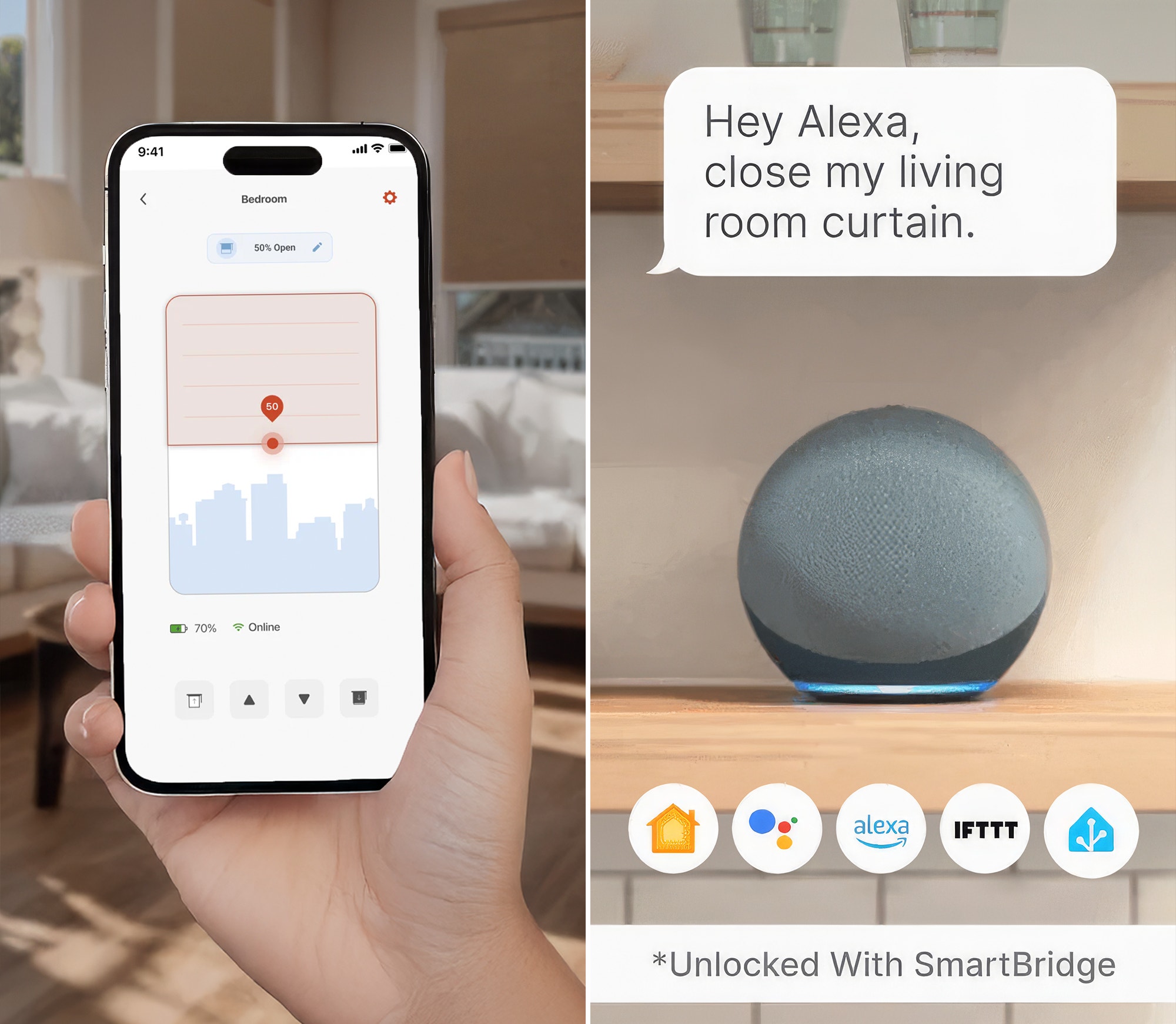
| Smart Home Integration | Alexa, Google Home, Apple HomeKit | Alexa, Google Home, HomeKit (varies) | Tie |
| App Required / Subscription | Free RYSE app, no subscription | Free–$10/mo depending on brand | RYSE |
| Works With Existing Blinds | Yes — roller, Roman, chain-pull | No — full replacement required | RYSE |
| Aesthetic / Custom Fabric Options | Depends on your existing blinds | Fully custom — hundreds of options | Traditional |
| Large / Commercial Windows | Limited by 10 lb weight limit | Handles very large, heavy treatments | Traditional |
RYSE wins 5 categories. Traditional motorized blinds win 3. They tie on 3. For most standard residential windows, RYSE SmartShade is the clear winner. Traditional motorized blinds earn their keep for very large/heavy treatments, full interior design projects where custom fabric matters, or permanent high-end installs.
Installation: The Experience Nobody Talks About
On paper, "professional installation" sounds reassuring. In practice, here is what it actually involves with traditional motorized blinds.
You schedule a consultation (often 1–2 weeks out). A specialist measures your windows. You browse fabric and motor options, confirm the order, and wait 4–8 weeks for fabrication. The installer returns, drills into your window frame or wall, runs wiring if the system is hard-wired, programs the motors, and leaves. Any future adjustments — limit settings, schedule changes — often require another service call or a technically involved process through a proprietary app.
With RYSE automated window shades DIY, the experience is genuinely different. You clip the motor onto the existing tube of your roller shade or chain mechanism, open the free RYSE app, set your open/close limits by pulling the shade to each position, and you're done. In our testing, the whole process from unboxing to first automated movement took under seven minutes. That includes the time spent reading the instructions once.
For renters especially, the portability factor is enormous. Traditional motorized blinds are a permanent modification. If you install them and then move, you either leave them behind (losing your entire investment) or uninstall them (risking damage deposits and leaving holes in the wall). RYSE SmartShade clips on and off in under a minute. You take it to the next apartment, clip it back on, and reconfigure in the app. Your investment moves with you.
Battery vs. Wired: Which Is More Reliable?
This is the most common concern people raise about battery motorized shades, and it's a fair one. The honest answer is nuanced.
Traditional hard-wired motorized blinds have one advantage: they never run out of power. As long as your home has electricity, the motor runs. For ultra-high-end installs in primary bedrooms or whole-home automation setups, that consistency is valuable.
However, the majority of traditional motorized blinds sold today — including most Hunter Douglas PowerView and Lutron Serena models — are also battery-powered or rechargeable. The wired advantage largely applies only to custom commercial or luxury residential installs. So the battery argument against RYSE is weaker than it initially appears.
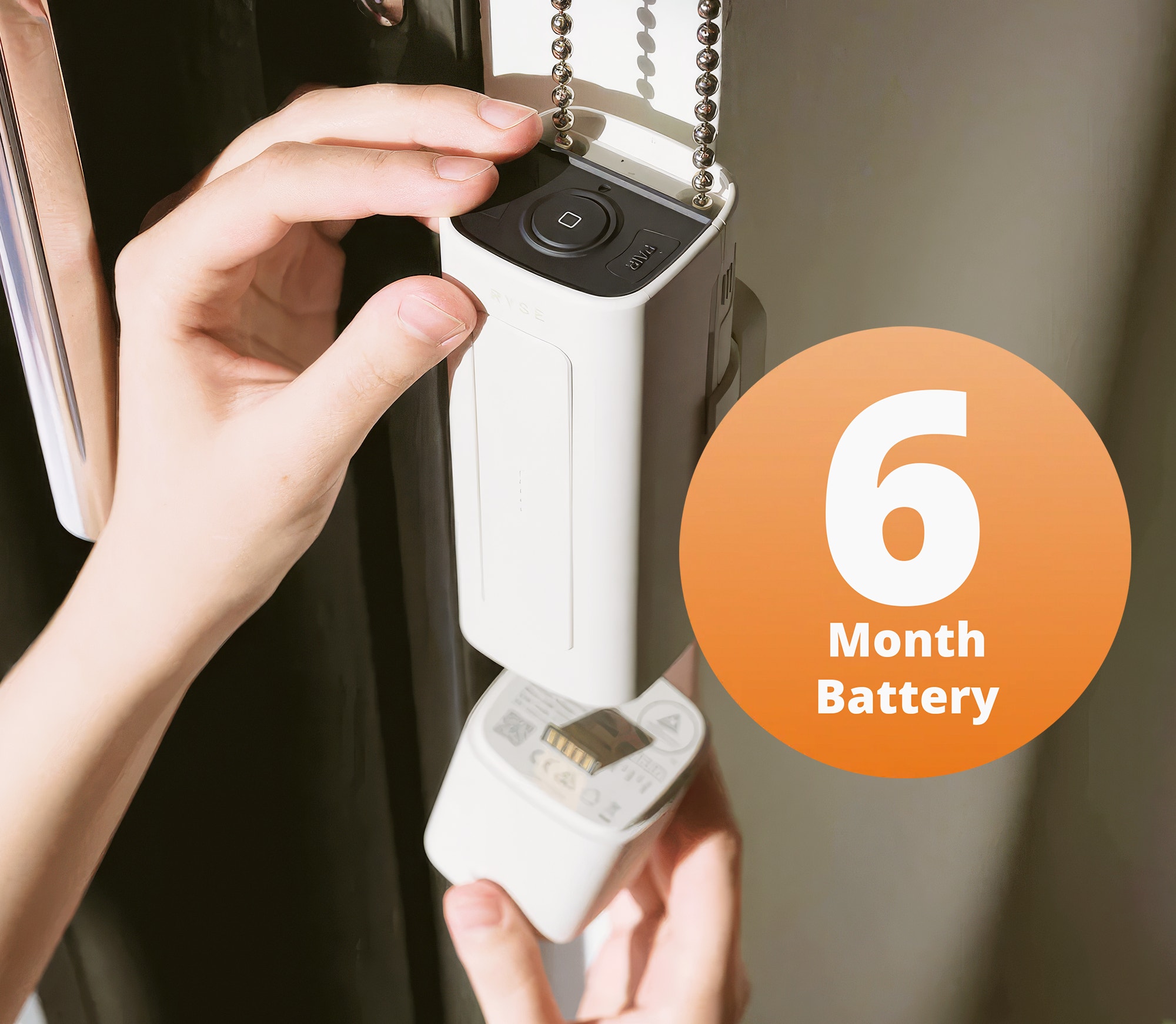
RYSE SmartShade's rated battery life is six months under typical use (two open/close cycles per day). In practice, users on the RYSE community forums and product reviews report 4–7 months depending on shade weight and usage frequency. Battery replacement (standard AA or USB-C rechargeable depending on the model) is straightforward.
The app sends a low-battery notification before the shade stops functioning, giving you ample warning. This is not a "wakes up one morning and the blinds don't work" scenario.
One genuine edge case where wired wins: if you have very heavy, wide blinds used 10+ times per day (a commercial setting or a very active household). For those use cases, the 10 lb motor load limit and battery drain rate on RYSE could become friction points. But for 90% of residential windows operated once or twice a day, battery performance is a non-issue.
Smart Home Integration: Does RYSE Keep Up?
One area where cheap motorized shades historically lagged was smart home integration. Early clip-on motors used proprietary RF remotes with no app, no voice control, and no scheduling.
RYSE SmartShade has closed that gap almost entirely. It supports:
- Amazon Alexa — "Alexa, close the bedroom blinds"
- Google Home — integrates with Google Assistant routines
- Apple HomeKit — works natively in the Home app with Siri and automations
- RYSE App — scheduling, scenes, sunrise/sunset automation, group control
The only smart blinds without rewiring option that outperforms RYSE on integration is the Lutron Caséta/RadioRA ecosystem — but that system starts around $400 per window for the shade alone, before installation.
For anyone already invested in an Alexa, Google Home, or HomeKit ecosystem, RYSE integrates seamlessly. You can tie it into morning routines ("when the alarm goes off, open the bedroom blinds"), movie modes ("when movie scene activates, close all living room blinds"), and sunset schedules without any hub or bridge required beyond a standard Wi-Fi router.
Who Should Buy RYSE SmartShade
This product is purpose-built for a specific buyer. RYSE SmartShade is the right choice if you are:
- A renter who wants smart shades without modifying the apartment
- A homeowner on a budget who wants to automate 3–6 windows without a $5,000+ project
- Someone who already owns compatible blinds and wants to add automation without replacing them
- Anyone who hates waiting — 5-minute install vs. 4–8 weeks lead time is not a small difference
- A smart home user already on Alexa, Google Home, or HomeKit
- Anyone moving frequently who needs their investment to be portable
Who Should Consider Traditional Motorized Blinds Instead
Traditional motorized blinds make more sense if you are:
- Designing a high-end interior from scratch where custom fabric is a priority
- Installing on very large or heavy window treatments (over 10 lbs) such as floor-to-ceiling drapery or oversized patio shades
- Building a whole-home Lutron or Control4 automation system at the luxury level
- A homeowner with a very long time horizon who never plans to move
Notice that the list is short, and most items apply to a small percentage of buyers. For the vast majority of people asking "how do I automate my blinds," the motorized blinds cost comparison points clearly toward the clip-on approach.
Bundle discounts available for multiple windows
FAQ: RYSE SmartShade vs. Traditional Motorized Blinds
Final Verdict: Is the $1,500 Savings Real?
Yes — with context. The "$1,500 savings per window" claim is accurate when comparing RYSE SmartShade to professionally installed mid-to-high-end motorized blind systems. It is not a comparison to a $200 motorized blind you order online and install yourself (which barely exists as a category). It is a comparison to the real-world cost most people face when they call a window treatment company and say "I'd like motorized blinds."
The motorized blinds cost comparison is not even close for the majority of buyers. RYSE wins on price, installation speed, portability, and ease of setup. Traditional systems win on load capacity for very heavy blinds, full custom fabric design, and ultra-premium aesthetics for high-end builds.
For renters, RYSE SmartShade is in a category of its own — there is simply no competitor that offers this level of smart home automation without permanent modification. For homeowners who want to automate several windows without a multi-thousand-dollar project, RYSE makes the math almost impossible to argue with.
The honest bottom line: if you have compatible blinds, a standard Wi-Fi network, and any of Alexa, Google Home, or Apple HomeKit — RYSE SmartShade delivers 95% of the experience of traditional motorized blinds for about 7% of the cost.
Exclusive Discount Available Now
Disclosure: This article contains affiliate links (Affiliate-Link / Werbung). If you purchase through our link, we may earn a commission at no additional cost to you. Our analysis and comparisons are based on publicly available pricing data and product specifications. Individual pricing for traditional motorized blinds varies significantly by region, installer, and product line.
Ready to Get Started?
Don't miss out on this exclusive offer!
Claim Your Discount → *This is an affiliate link. We may earn a commission at no extra cost to you.