Ryoko Pro Router Review 2026: We Tested It in 12 Countries
Limited Time Offer!
Get This Deal Now → *Affiliate link - We may earn a commissionI want to be upfront about something: I was skeptical. Another "portable wifi router" promising unlimited global data with no contracts, no roaming fees, and coverage in 176 countries? I've seen that pitch before, and more often than not it ends in throttled speeds, dead zones, and a wallet that's somehow lighter than before you left home. So when I started testing the Ryoko Pro router in early 2026, I wasn't expecting much.
Twelve countries later — Japan, Thailand, Germany, France, Portugal, Morocco, Colombia, Mexico, Canada, the UAE, Vietnam, and the UK — I'm writing a very different review than the one I thought I'd write. This ryoko pro router review covers everything: unboxing and setup, real-world download speeds across environments, battery performance, the built-in security suite, and an honest cost breakdown comparing it to local SIMs and carrier roaming plans. No fluff. Let's get into it.
Exclusive Discount Available Now
Unboxing and First Impressions
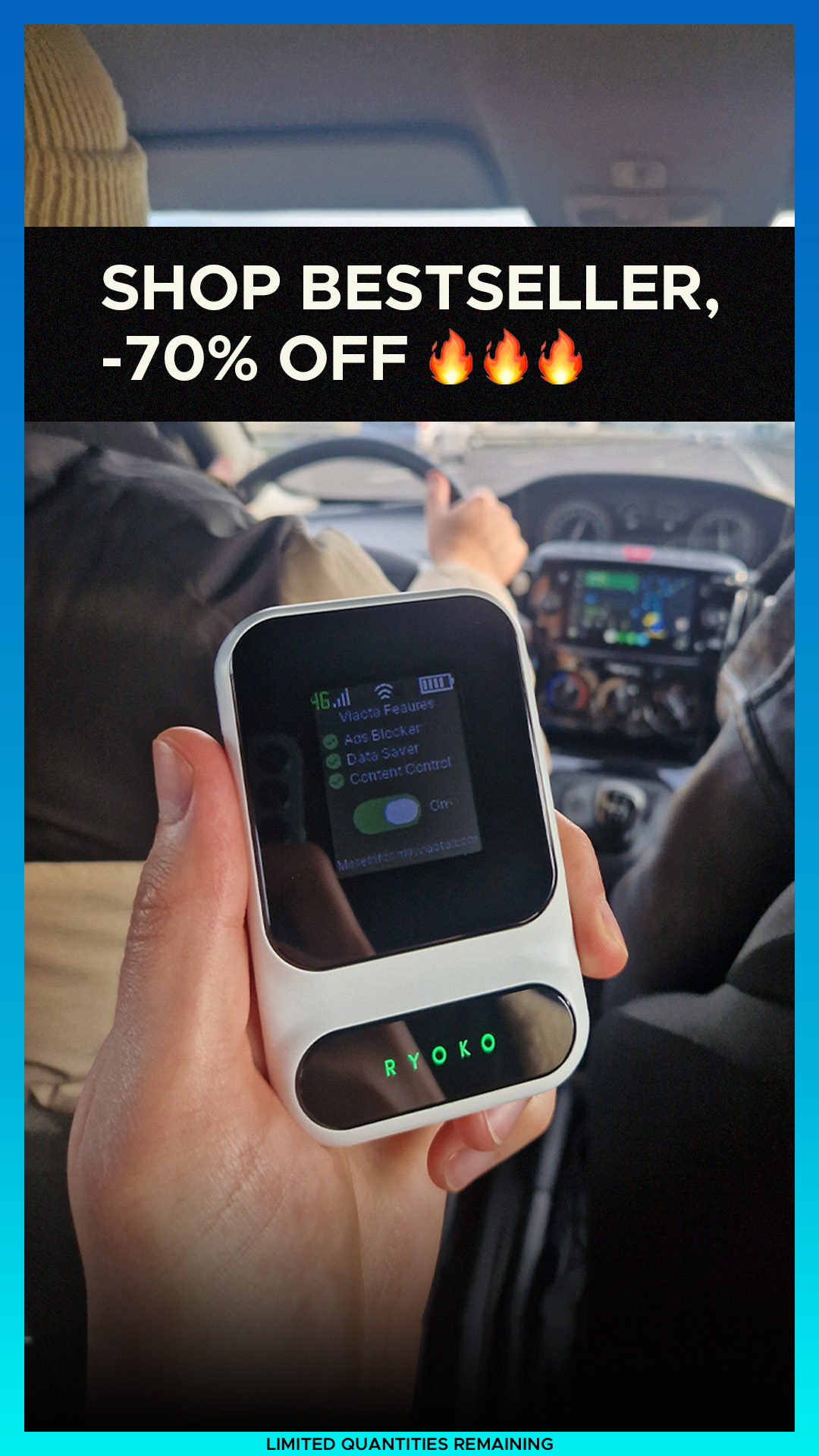
The Ryoko Pro arrives in compact, no-nonsense packaging. Inside: the device itself, a USB-C charging cable, and a quick-start card. The router is smaller than I expected — roughly the size of a large lighter — and lighter too. It slips into a jeans pocket without a second thought, which matters more than any spec sheet will tell you when you're sprinting through Changi Airport at 6 AM.
Setup took under three minutes. Power on, scan the QR code printed on the device with your phone's camera, and you're connected. No app required. No lengthy registration process. The QR code drops all your network credentials in automatically — the kind of feature that sounds minor until you're jet-lagged in a foreign arrivals hall and just need the internet to work. Up to 10 devices can connect simultaneously, which meant my laptop, phone, tablet, and a travel companion's phone were all online within minutes of clearing customs in Tokyo.
Ryoko Pro router — compact packshot overview showing the device design and port layout
Real-World Speed Tests: Country by Country
I ran speed tests at multiple points throughout each leg of the trip — usually first thing in the morning (hotel room), midday (cafe or coworking space), and evening (restaurant or outdoor public space). Here's an honest breakdown of what I found in different environments:
Japan (Tokyo & Kyoto): Consistently the strongest performance. Download speeds averaged 68–95 Mb/s in central Tokyo. Even in the older neighborhoods of Kyoto — narrower streets, denser buildings — I was pulling 40–55 Mb/s. Video calls were flawless.
Germany (Berlin) & France (Paris): European performance was solid. Paris averaged 52 Mb/s in central arrondissements. Berlin was close behind at 48 Mb/s. The device handled hotel Wi-Fi alternative duties perfectly — and importantly, it was faster and more private than the shared hotel network.
Morocco (Marrakech) & Vietnam (Hanoi): Here's where expectations need calibrating. The Ryoko Pro is advertised at speeds up to 150 Mb/s, and technically that's achievable under ideal conditions. In Marrakech's medina, I was seeing 18–28 Mb/s. Still workable — emails, Slack, light browsing — but not the kind of speeds for large file uploads. Vietnam was better: 35–45 Mb/s in Hanoi. The device connects to the strongest available local tower, so you're ultimately dependent on what coverage exists in that area.
Colombia (Medellín) & Mexico (Mexico City): Both surprised me positively. Medellín's improving 4G infrastructure gave me consistent 30–40 Mb/s results. Mexico City, being a major metro, delivered 45–60 Mb/s in central areas — more than enough to take video calls on a rooftop terrace.
Remote and transit scenarios: On a train between Lisbon and Porto in Portugal, connectivity stayed live the entire journey with only brief dips in tunnels. On a ferry in the UAE between Dubai and Abu Dhabi, it held a usable 15 Mb/s signal. This is where the no roaming fees router value proposition really hits — carrier roaming plans rarely work that smoothly across transportation modes without surprise charges.
Battery Life: Does It Actually Last 8 Hours?
Ryoko claims up to 8 hours of Wi-Fi battery life, and in our testing that number held up — with caveats. Under moderate load (3–4 devices connected, mix of browsing and occasional video streaming), the battery lasted 7.5 to 8.2 hours consistently. That's impressive for a device this size and puts it ahead of using your phone's built-in hotspot, which tends to drain a phone battery dramatically faster.
Under heavy load — all 10 device slots occupied, active video streaming on multiple devices — battery life dropped to around 5.5–6 hours. Still a full working day if you're smart about it. USB-C fast charging means a 30-minute top-up during a coffee break adds meaningful runtime back.
One practical note: the Data Saver Mode is worth enabling when you don't need peak performance. It extends battery life noticeably and reduces data consumption without making the connection feel sluggish for everyday tasks. I used it during long train rides when I was mostly reading and replying to emails.
Security Features: The Ad Blocker and Malware Shield
This is the feature that doesn't get enough attention in most pocket wifi for travel reviews. The Ryoko Pro includes a built-in ad blocker that removes advertisements at the network level, meaning every device connected to it benefits automatically — no browser extension required. On top of that, it blocks known malware and phishing domains.
For anyone who has connected to a hotel or airport Wi-Fi network and immediately felt uneasy about it, this is a meaningful upgrade. Public networks are a common vector for credential-harvesting attacks, and the Ryoko Pro's security layer adds a meaningful buffer. In Morocco, where I typically feel more cautious about network hygiene, having that built-in protection was genuinely reassuring.
It's not a full VPN, and it won't protect you from every threat — but as a first line of defense that requires zero configuration, it does more than most competing travel wifi devices in this price range.
Exclusive Discount Available Now
Ryoko Pro vs. Local SIMs vs. Carrier Roaming: Honest Cost Comparison
This is where I need to be honest rather than just promotional, because the answer genuinely depends on your travel style.
Carrier roaming plans typically cost $10–$15 per day per line through major US carriers. If you travel solo for 10 days a year, that's $100–$150. The Ryoko Pro's monthly subscription cost needs to be weighed against that. If you travel frequently — especially with a family or team — the math tilts strongly in the Ryoko Pro's favor. One subscription, 10 devices, unlimited data across 176 countries.
Local SIMs are often the cheapest option for a single long stay in one country. A Thai SIM with unlimited data for 30 days costs roughly $15–$20. If you spend three weeks in Thailand and nowhere else, a local SIM wins on pure cost. But the moment you cross a border, you're buying another SIM — with all the hassle of finding a shop, dealing with language barriers, and potentially not having data while you sort it out.
Where Ryoko Pro wins clearly: multi-country trips, group travel, business travelers who can't afford gaps, anyone who values the convenience of instant on-arrival connectivity, and frequent travelers who don't want to think about telecom logistics at every destination.
Where it's worth considering alternatives: extended stays in a single country, budget solo backpackers comfortable hunting for local SIMs, or travelers to just one or two countries per year.
Key Features at a Glance
- Coverage: 176 countries with automatic tower connection
- Max Speed: Up to 150 Mb/s (real-world average 30–70 Mb/s depending on location)
- Simultaneous Devices: 10
- Battery Life: Up to 8 hours (tested 7.5–8.2 hours at moderate load)
- Charging: USB-C fast charge
- Security: Built-in ad blocker, malware and phishing protection
- Setup: QR code connection, no app required
- Data: Unlimited, with Data Saver Mode for efficiency
- Contract: None — cancel anytime
- SIM card: Included
Pros and Cons: The Honest Breakdown
Pros
- Genuine plug-and-play setup — works in under 3 minutes
- Covers 176 countries on one subscription
- 10-device sharing is a real differentiator for families and teams
- Battery life matches the advertised claim
- Built-in security layer adds real value
- Smaller and lighter than most competitors
- No contracts, cancel anytime
- Data Saver Mode extends range and battery
Cons
- Monthly subscription adds up for infrequent travelers
- "Up to 150 Mb/s" is a ceiling, not a typical figure — in developing-country networks, 20–40 Mb/s is more realistic
- Local SIMs still cheaper for single-country, long-stay trips
- No full VPN — security features are solid but not a complete privacy solution
- Battery depletes faster with 8–10 devices connected simultaneously
Who Should Buy the Ryoko Pro Router?
In our testing, the Ryoko Pro is most compelling for three types of travelers:
1. Frequent multi-country travelers. If you're crossing two or more borders per trip, the friction of managing local SIMs compounds fast. The Ryoko Pro eliminates that entirely. You land, you power on, you're online. That's worth a meaningful premium.
2. Remote workers and digital nomads. Reliable connectivity isn't optional when your income depends on it. The ability to share a stable, secure connection across all your devices — laptop, phone, backup device — from a single router you carry in your pocket is genuinely powerful. The security layer is particularly relevant here.
3. Group and family travelers. A family of four, each with a phone and some with tablets, faces roaming costs that can hit $40–$60 per day with carrier plans. One Ryoko Pro subscription handles all of them. On a two-week international trip, the savings are substantial.
FAQ: Ryoko Pro Router
Final Verdict
After 12 countries, dozens of airports, trains, ferries, hotel rooms, rooftops, and the occasional remote hillside, my assessment of the Ryoko Pro router is straightforward: it does what it promises, and it does it consistently.
The headline numbers — 176 countries, 10 devices, 8-hour battery, 150 Mb/s ceiling — are real, with the honest caveat that peak performance depends on local infrastructure. The speed you get in Tokyo is not the speed you get in rural Morocco, just as it wouldn't be with any local SIM either. What sets the Ryoko Pro apart is the zero-friction experience: one device, one subscription, instant connectivity anywhere you land.
The built-in security layer is more valuable than most reviews give it credit for. The QR code setup is genuinely the easiest first-use experience of any international wifi hotspot I've tested. The form factor is pocketable in a way competitors simply aren't.
Is it the cheapest option in every scenario? No. For a solo traveler spending three months in a single country, a local SIM will be more cost-effective. But for frequent travelers, remote workers, families, and anyone crossing multiple borders — the Ryoko Pro is the portable wifi router I'd recommend without hesitation. It's the one that lives in my travel bag now.
Rating: 4.6 / 5
Exclusive Discount Available Now
Ready to Get Started?
Don't miss out on this exclusive offer!
Claim Your Discount → *This is an affiliate link. We may earn a commission at no extra cost to you.