Breathing Exercises to Quit Smoking: Can Breathwork Really Help?

Every smoker knows the feeling: a craving hits, it feels absolutely overwhelming, and within seconds your hand is already reaching for the pack. What most people don't know is that the urge itself — if you do nothing to feed it — will peak and fade on its own within three to five minutes. Breathing exercises to quit smoking work precisely because they give you something purposeful and physiologically active to do during that critical window. But how much does the science actually support this? And which techniques work best for which situations? This guide breaks it all down.
The 3-to-5 Minute Craving Window: Why It Matters
Nicotine cravings follow a predictable arc. Research published in the journal Nicotine & Tobacco Research consistently shows that peak craving intensity — the sharpest, most urgent part — typically lasts between three and five minutes before naturally declining, even without any intervention. The problem is that most people capitulate during that window, which reinforces the habit loop. They never discover that riding it out is possible.
This is where breathwork for nicotine cravings becomes strategically powerful. A controlled breathing exercise typically takes two to four minutes to complete. That puts you almost exactly at the tail end of the craving peak by the time you finish. You haven't just distracted yourself — you've physiologically shifted your nervous system state while waiting out the biological urge. The craving doesn't disappear, but its intensity drops to a manageable level.
The key insight: you don't need to eliminate the craving. You only need to survive its peak. Breathwork is one of the most effective tools for doing exactly that.
How Smoking Hijacked Your Breathing Pattern
Here's something most cessation programs miss entirely: smoking is, at its core, a breathing behavior. When you light a cigarette, you perform a long, slow, controlled inhale — drawing air deliberately, filling your lungs, then releasing with a slow exhale through pursed lips. That pattern — deep diaphragmatic inhale, slow exhale — is functionally identical to what yoga teachers, therapists, and stress researchers prescribe as an acute relaxation technique.
Nicotine is a real pharmacological agent, but part of smoking's stress-relief effect is neurologically tied to the breath itself. A 2018 study in Psychopharmacology found that the act of smoking — independent of nicotine delivery — produced measurable reductions in self-reported stress, suggesting the ritual and the respiratory pattern both contribute to its calming effect. This is not a minor footnote. It means that when you quit, you're not just withdrawing from a drug — you're also losing a deep breathing reflex you've been using as a stress-management tool for years.
The good news: that reflex can be replaced. The slow-exhale mechanism that made smoking feel relaxing can be reproduced without a cigarette. Quit smoking naturally techniques built around breath control are partly exploiting this very substitution.

What the Research Says About Breathwork and Cravings
The evidence base for does deep breathing help quit smoking is still developing, but several well-designed studies point toward real, measurable effects.
A landmark 2013 study published in Drug and Alcohol Dependence by Shahab and colleagues assigned smokers to either a yoga/breathing intervention or a waitlist control during a quit attempt. The breathing group showed significantly reduced craving intensity and improved cessation rates at 12-week follow-up compared to controls. The specific mechanism wasn't fully isolated, but the authors theorized that breathwork reduced both physiological arousal and the cognitive salience of cravings.
A 2019 systematic review in BMC Complementary Medicine and Therapies examined mindfulness-based interventions for smoking cessation and found consistent evidence that techniques involving controlled breathing reduced "craving-related attentional bias" — meaning smokers were less likely to fixate on smoking cues in their environment when they had a regular breathwork practice.
Finally, a 2020 randomized controlled trial in Addictive Behaviors specifically tested slow-paced breathing (six breath cycles per minute) against passive relaxation during experimentally induced cravings. The slow-breathing group showed greater reductions in craving intensity and heart rate, and reported higher confidence in their ability to resist smoking. The physiological explanation: slow breathing at approximately five to six cycles per minute activates the vagus nerve and increases heart rate variability (HRV), both markers of parasympathetic dominance — essentially the opposite of the fight-or-flight state that makes cravings feel so urgent.
5 Breathing Techniques Mapped to Quit-Smoking Contexts
Not all breathwork is equal for cessation. Different techniques serve different moments in the quitting process. Here are five approaches and when to use each.
1. Pursed-Lip Exhalation (The Drag Substitute)
This is the single most important technique for new quitters. The pursed-lip exhale — breathing in through the nose for two counts, then releasing slowly through tightly pursed lips for four to six counts — directly mimics the physical sensation of a cigarette drag. The resistance created by the pursed lips slows exhalation, increasing intrathoracic pressure in a way that feels surprisingly similar to the draw-and-release of smoking.
When to use it: Immediately when a craving hits, especially during the first two weeks of quitting. Perform eight to ten cycles. This technique directly addresses the oral and respiratory component of the habit, not just the nicotine withdrawal.
2. Box Breathing (Craving Containment)
Box breathing — inhale for four counts, hold for four, exhale for four, hold for four — is used by military personnel and first responders to manage acute stress. For quitting smokers, it works best for cravings that are triggered by high-stress situations (a difficult phone call, a deadline, a conflict). The deliberate counting occupies the prefrontal cortex, reducing the cognitive bandwidth available for craving-related rumination.
When to use it: Stress-triggered cravings. Work through four to six complete cycles (about two minutes).
3. 4-7-8 Breathing (Evening Withdrawal Management)
Developed by Dr. Andrew Weil and rooted in pranayama tradition, 4-7-8 breathing involves a four-count inhale through the nose, a seven-count breath hold, and an eight-count exhale through the mouth. The extended breath retention and long exhale trigger a strong parasympathetic response, making it particularly effective for the anxiety and restlessness that peaks in the evening during early withdrawal.
When to use it: Evenings, pre-sleep, and during anxiety peaks. Begin with four cycles and work up to eight. Note: some people feel lightheaded initially — this is normal and passes within a few days of practice.
4. Diaphragmatic Breathing (Daily Foundation)
Simple diaphragmatic or "belly" breathing — placing one hand on the chest and one on the belly, and breathing so only the lower hand rises — rebuilds the healthy breathing pattern that years of shallow, stress-driven smoking may have disrupted. Chronic smokers often develop chest-dominant breathing patterns that maintain a low-level state of physiological stress. Regular diaphragmatic practice recalibrates this baseline.
When to use it: Daily, ideally every morning for five to ten minutes. This is the foundation technique — think of it as maintenance rather than crisis response.
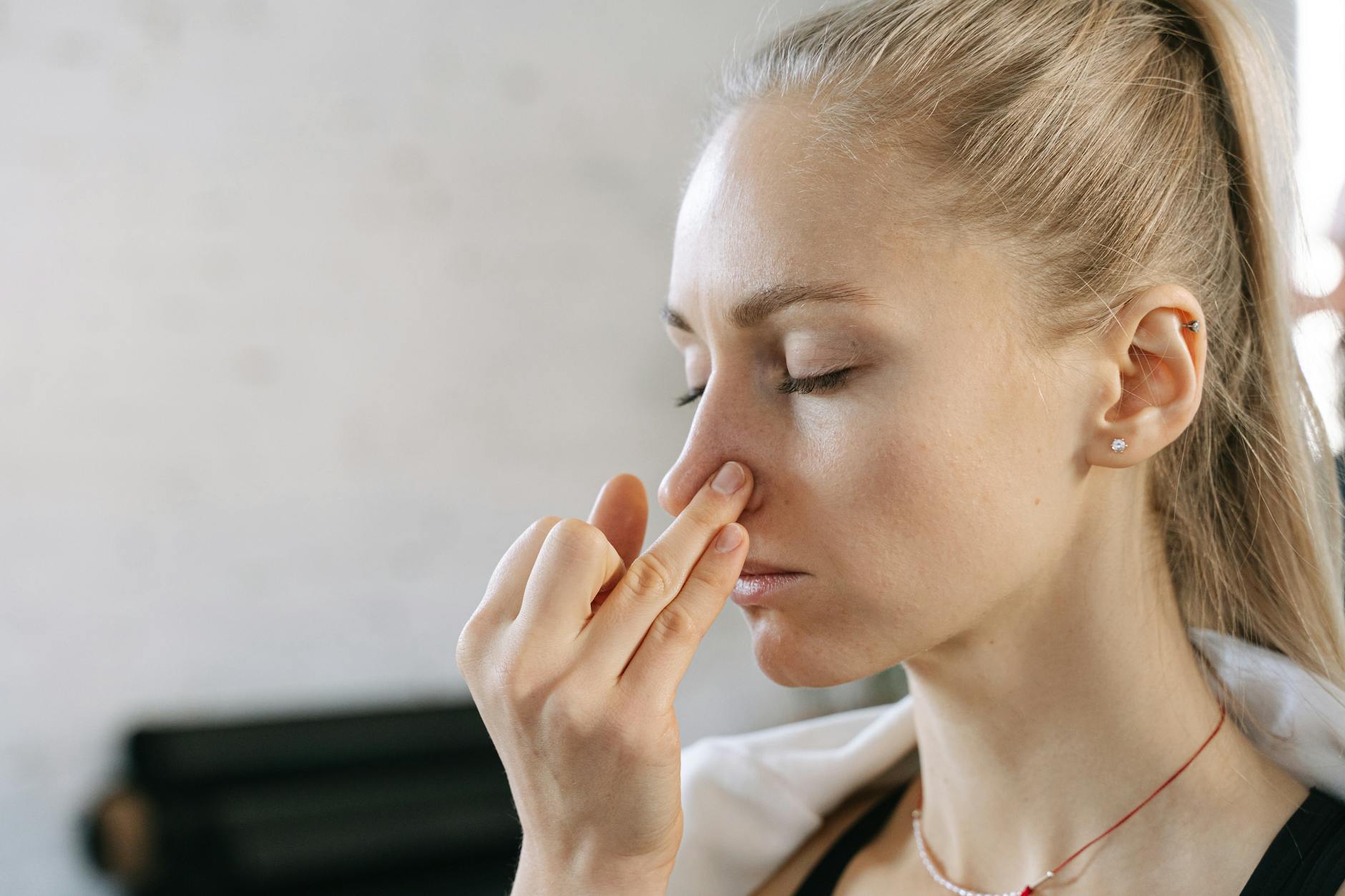
5. Alternate Nostril Breathing / Nadi Shodhana (Mood Regulation)
A classical pranayama technique, alternate nostril breathing involves closing the right nostril with the thumb, inhaling through the left, then switching to close the left and exhaling through the right, cycling back and forth. Research suggests this technique may help balance left and right hemispheric brain activity and has been linked to reductions in anxiety and improvements in cardiovascular function. For quitters, its primary value is withdrawal symptom breathing support during the mood swings and irritability that characterize early cessation.
When to use it: Mid-morning or mid-afternoon, when mood dips and irritability peaks. Five minutes is sufficient.
The Oral Fixation Problem Breathwork Alone Cannot Solve
Honest assessment requires acknowledging the limits of breath-based interventions. Smoking involves at least three interlocking dependencies: the pharmacological nicotine addiction, the behavioral habit loop, and the oral fixation — the physical need to have something in the mouth and hands. Breathwork addresses the behavioral and autonomic dimensions powerfully but does not satisfy the oral fixation or deliver nicotine.
For heavy smokers (more than a pack a day), going cold turkey with breathwork alone may be insufficient. The craving waves can be intense enough and frequent enough that no breathing practice can fully compensate, particularly in the first 72 hours when blood nicotine levels drop sharply. This doesn't mean breathwork is ineffective — it means it works best as part of a broader strategy rather than as a standalone intervention.
Combining breathwork with nicotine replacement therapy (NRT), whether patches, gum, lozenges, or other approved methods, addresses both the neurochemical and the behavioral dimensions simultaneously. The breathing exercises handle the anxiety spikes and the habit-ritual gap; the NRT handles the physiological withdrawal. Research consistently shows combination approaches outperform single-method attempts.
Your Quit-Day Breathwork Protocol
A structured daily schedule turns scattered breathing attempts into a reliable system. Here is a stop smoking without medication-compatible protocol for the critical first two weeks.
Morning (5-10 minutes): Begin with diaphragmatic breathing immediately after waking, before checking your phone. This sets your autonomic baseline for the day and reduces the cortisol-driven cravings that are strongest in the morning — the time when many smokers report their first automatic urge.
On every craving (2-4 minutes): Deploy the pursed-lip exhalation technique the moment a craving begins. Perform at least eight cycles. Pair this with a simple cognitive cue — tell yourself "I am riding the wave" — to reinforce the awareness that the craving is temporary and time-limited.
Stress triggers (2 minutes): When a high-stress moment arises that would previously have sent you outside for a cigarette, use box breathing for four to six cycles before making any other decision. The two-minute pause creates enough of a circuit-breaker to prevent automatic craving-to-smoking behavior.
Mid-day mood dip (5 minutes): Around 2-3 PM, when withdrawal-related fatigue and irritability often peak, practice five minutes of alternate nostril breathing. This is the most likely time for relapse during a quit attempt — building a scheduled practice here pre-empts the most dangerous window.
Evening wind-down (5 minutes): Use 4-7-8 breathing as part of your nighttime routine. Nicotine withdrawal disrupts sleep architecture, and the deep parasympathetic activation from this technique improves sleep onset and reduces the nighttime restlessness that triggers early-morning relapse.
Building the Habit: Making Breathwork Stick During Quitting
The paradox of quitting smoking is that you're trying to build a new behavior (breathwork practice) while simultaneously dismantling an old one (smoking) — during a period when your willpower and executive function are depleted by withdrawal. This is why implementation is as important as technique selection.
Research on habit formation suggests that "habit stacking" — attaching a new behavior to an existing anchor — significantly improves adherence. For quitting smokers, this means pairing your breathing practices with existing daily anchors: morning diaphragmatic breathing immediately after brushing teeth; pursed-lip exhalation every time you sit in your car (a common smoking trigger); box breathing whenever you put down a coffee cup (another common trigger pairing).
Physical reminders help. Some people place a small reminder — a sticky note, a rubber band on the wrist, or a specific app notification — at locations or times that were previously smoking cues. When the cue fires, the reminder redirects them to breathwork instead of the automatic smoking response.
Progress is not linear. Most successful quitters make multiple attempts before achieving long-term cessation. Using breathwork after a slip rather than abandoning the practice entirely is more predictive of eventual success than any single technique.
What to Combine with Breathwork for Best Results
The strongest evidence for smoking cessation points to multimodal approaches. Here is what the research supports combining with a breathwork practice:
Nicotine Replacement Therapy (NRT): Patches, gum, and lozenges approved by the FDA roughly double cessation success rates compared to cold turkey. They do not preclude breathwork — the two approaches operate on different mechanisms and complement each other well.
Cognitive Behavioral Therapy (CBT): CBT-based cessation programs teach smokers to identify their personal trigger situations (stress, boredom, social settings, alcohol) and develop specific responses. Breathwork fits naturally as the behavioral response strategy within a CBT framework.
Physical exercise: A growing body of research, including a 2012 Cochrane review, found that exercise reduces cigarette cravings in the short term and may improve long-term abstinence rates. Even a five-minute brisk walk produces craving reduction comparable to nicotine replacement. Pairing a short walk with a breathing exercise on craving — moving through diaphragmatic breathing while walking — leverages both mechanisms simultaneously.
Social support: Peer support, whether through cessation groups, phone-based quit lines, or trusted friends and family who know about the quit attempt, consistently improves outcomes. No breathing practice operates in isolation from the social and psychological environment of the quitter.
Key Takeaways
The case for breathing exercises to quit smoking is grounded in real physiology and supported by a growing body of clinical evidence. Breathwork works not by eliminating cravings but by giving you an evidence-based strategy to survive their three-to-five minute peak, by retraining the stress-relief reflex that smoking hijacked, and by activating the parasympathetic nervous system at exactly the moments when withdrawal anxiety is at its most acute.
The five core techniques — pursed-lip exhalation, box breathing, 4-7-8 breathing, diaphragmatic breathing, and alternate nostril breathing — address different moments in the quitting experience and are most powerful when deployed as a structured daily protocol rather than used reactively. Honest about limitations, breathwork is not a substitute for NRT in heavy smokers, and the oral fixation component of smoking requires additional strategies. But as one layer of a comprehensive quit plan, it may be the most underutilized and accessible tool available — requiring no equipment, no cost, and no prescription.
The next time a craving hits, you have three to five minutes of science on your side. Put your lips together, breathe slowly out, and let the wave pass.